Steinvar LedgerAccounts and general ledgerA double-entry ledger that closes its books.
Every account, posting and balance in Steinvar sits on one ledger. Transaction types and their posting rules are configuration your finance team approves, money is decimal from the request to the report, and the books close by month and by year under two pairs of eyes.
The HQ back office; the workplace and people’s names are blurred.
- Decimal
- money on every write path, never floating point
- Hourly
- reconcile of the ledger against account balances
- 4-eyes
- on manual journals, corrections and period closes
Accounts
Multi-currency accounts
One account carries a balance per currency, each with its own GL account and IBAN; IBANs are issued with check digits from an atomic counter.
Holds
Funds reserved by reference with an expiry, released or captured in part or in full from the back office or a processor’s internal API. Spending checks the balance less live holds in the same update that moves it.
Arranged overdrafts
A limit is asked for by one employee and approved by another, within the maximum the account’s template offers. Debit interest accrues nightly and is charged monthly; loan repayments, deposit funding and FX cannot use the limit.
Customer limits
Per transaction, per day, per month, per hour and by daily count, enforced on every payment the customer makes.
Status lifecycle
Frozen, dormant, blocked and closed, each change approved by a second employee; the booking guard refuses movements the status forbids.
Account terms
Service fees and credit interest from the account’s template version, applied each night; a new template version changes new accounts only.
Postings
Operations as configuration
Each transaction type names its legs with symbolic accounts (debtor, creditor, clearing) and is versioned: a draft, a second approver, then live.
Checked before it books
Balance, limits, account status, screening, GL rules and the business date are checked first; a refusal carries a stable code, and nothing moves.
Append-only
Postings are never edited. A mistake is corrected by a maker-checker correction, and a chart change by restating through reclassification, both on the record.
Manual journals
Direct GL operations need an idempotency key and a second approver, and compensate themselves if a leg fails.
Value and business dates
Every row carries both. Night jobs post exactly once from a journal, and an outcome that cannot be known is held for a person instead of retried.
Fees as rules
Price lists are rule sets per workplace, tested with a dry run before they apply, and booked as their own instruction.
Chart, close and FX
Chart of accounts
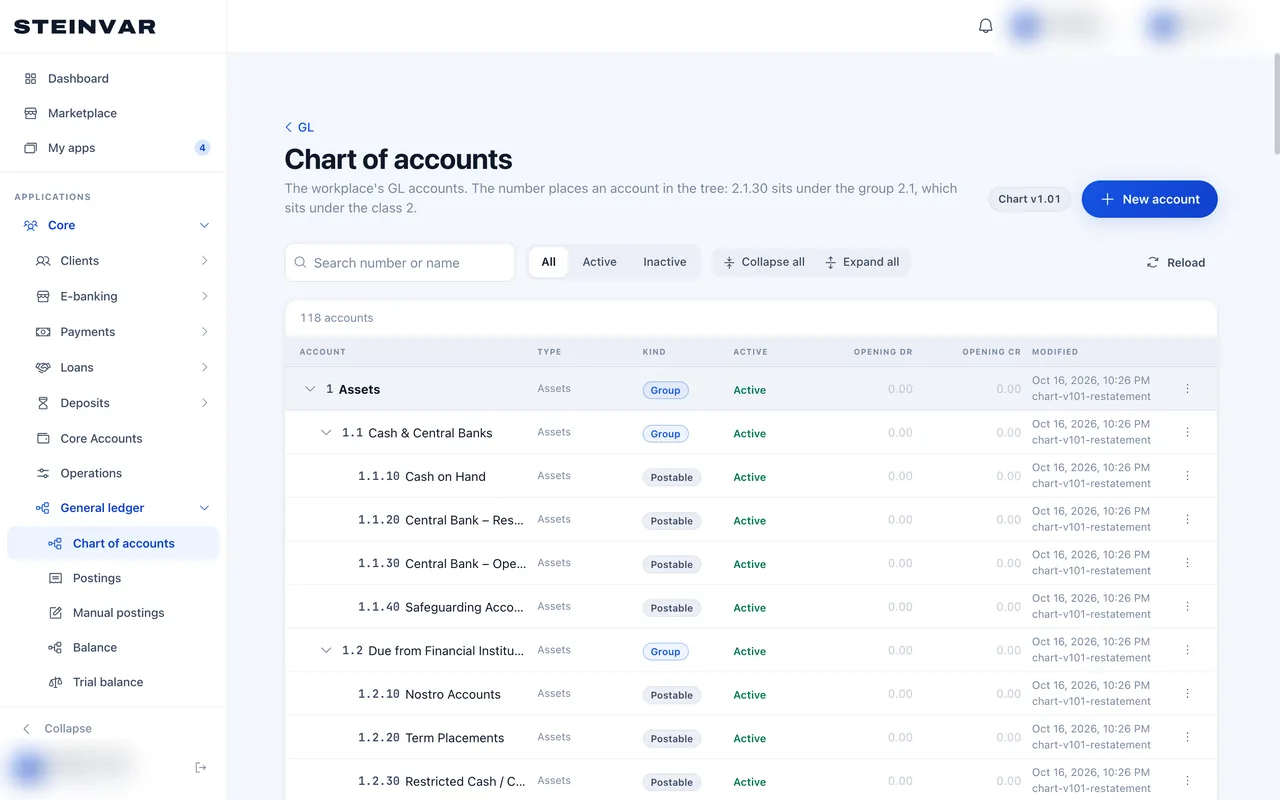
Hierarchical, per workplace, versioned, edited in the back office; debit-normal and credit-normal accounts are enforced at validation.
Month and year end
A period gate, month close and reopen, and a year end that carries profit and loss into retained earnings. Each close keeps a snapshot of the trial balance.
Trial balance and reconcile
A trial balance from the ledger in the back office, and an hourly reconcile of ledger rows against account balances, loans included, that freezes on drift.
FX
Bank of Lithuania reference rates with history, margins under maker-checker, 60-second single-use quotes and decimal revaluation.
The bank’s own day
Day open and close per workplace in the bank’s own time zone, with holiday calendars; the business date never moves backwards.
How a posting moves
Instruction
A payment, a night job or an employee creates an instruction for an operation.
Validation
Balance, holds, limits, status, screening and the business date are checked; a refusal stops it with a code.
Posting
The legs post to account balances, statements and the ledger, each row with value and business dates.
Reconcile
Every hour the ledger is checked against account balances; drift freezes posting and alerts operations.
Close
At month end one employee asks to close and another approves; the trial balance is kept as it stood.
Controls built in.
Maker-checker
Operation versions, manual journals, corrections, account status, overdraft limits, FX margins and period closes each need a second employee.
Audit trail
Every change is written to the platform audit trail: signed, hash-chained per workplace and sealed every 15 minutes.
Guarded balances
A debit moves a balance only in the same atomic update that checks it, so two payments cannot spend the same money.
Standards and formats
- Double entry
- Decimal128
- IBAN (ISO 13616)
- ISO 4217
- Bank of Lithuania FX rates
Not in this module today
- Nostro and external bank-statement reconciliation are on the roadmap.
- The platform runs on one host today; high availability is on the roadmap.
Questions about Steinvar Ledger
Can we bring our own chart of accounts?
Yes. The chart is per workplace and versioned; you edit it in the back office, and the platform’s own roles (customer funds, accrued interest, tax payable) are mapped to your accounts.
How are mistakes corrected?
With a correction: one employee proposes it, a second approves it, and it posts as new rows. Nothing already posted is edited or deleted.