Steinvar LendConsumer loansFrom application to collection, under two pairs of eyes.
Steinvar Lend runs a consumer loan from the offer in e-banking to its last instalment: affordability with a second approver, an agreement signed in Docs, interest accrued daily, repayments collected nightly, a dunning ladder when payments stop, and an expected-loss allowance each month.
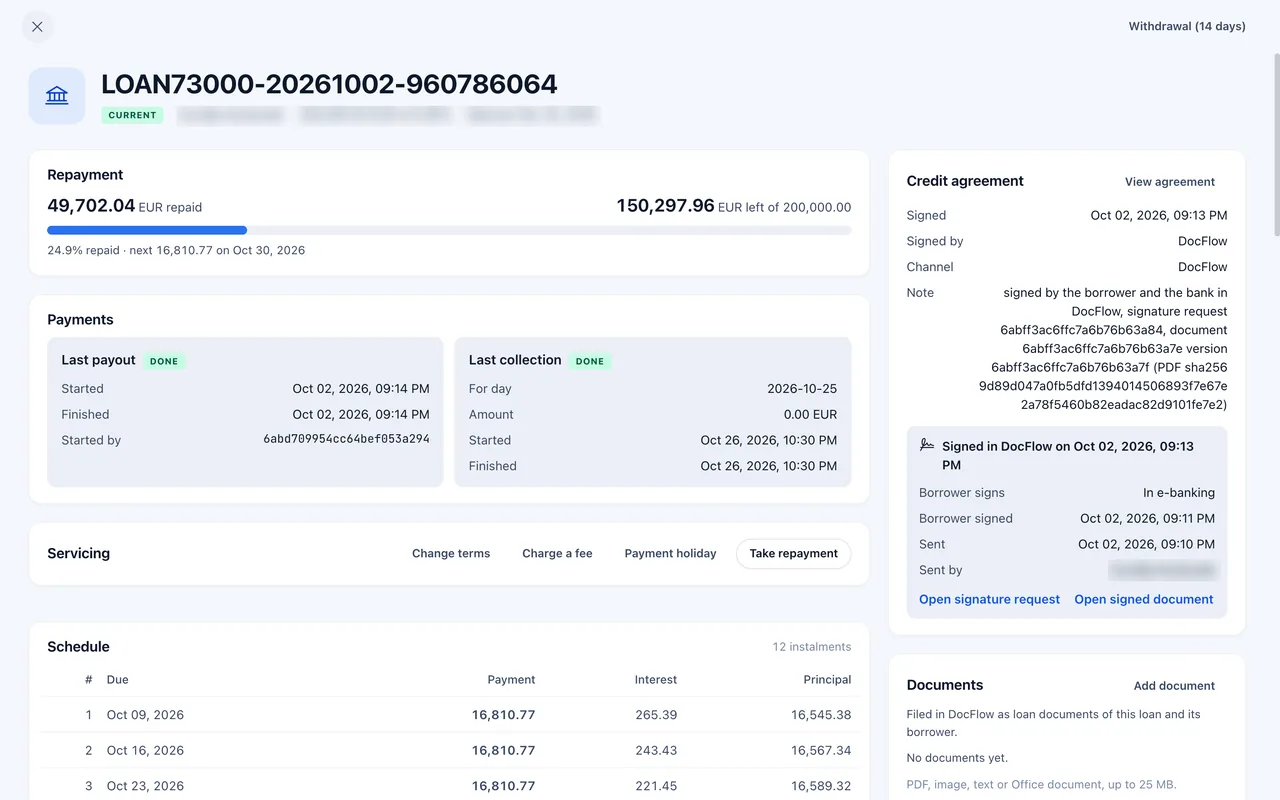
The HQ back office; the workplace and people’s names are blurred.
- 6
- schedule shapes, from annuity to custom
- Daily
- interest accrual against an interest receivable
- IFRS 9
- staging and expected credit loss each month
Origination
Offers and applications
Offers in e-banking, applications with declared income, obligations and employment, and HQ opening for loans agreed in a branch.
Affordability
Debt-service-to-income from declared and observed income, the borrower’s loans with the bank, and a Decision rule-set verdict.
Approval
An override needs a reason; above a threshold or against a decline, a second employee approves.
Agreement
APRC and the agreement from the same terms, signed in Docs by the borrower and then the bank; a 14-day right of withdrawal.
Products
Schedule shapes
Annuity, equal principal, bullet, an interest-only period, balloon and custom schedules agreed per loan.
Rates
Fixed, or variable on a reference rate plus margin with reset days and an optional floor; reference rates entered under four-eyes.
Fees
Arrangement, monthly administration, and fees for events such as early repayment within the legal cap, a change of terms or a holiday.
Consumer-credit caps
Late interest, APRC and penalties held to the caps at every quote, opening and change.
Servicing
Disbursement
Paid out by a second employee; an outcome that cannot be known is held, and the schedule is rebuilt from the payout date.
Accrual and collection
Interest accrues daily against a receivable; repayments are collected each night, partial when funds are short, with catch-up.
Repayment waterfall
Penalties, fees, interest and principal, oldest first. Early repayment reduces the payment or the term, and keeps the due day.
Holidays and restructuring
Principal-only or full payment holidays and term or rate changes, each under four-eyes; a holiday for financial difficulty marks the loan forborne.
Collections and credit risk
Collection cases
A case for each overdue spell, a versioned dunning ladder, promises to pay, and letters as PDFs in e-banking announced by e-mail.
Formal demand and agencies
The formal demand goes out only by two employees. Agencies are kept in a registry, handed a case file and recallable.
Borrower papers
Statements, payoff letters, interest certificates and arrears notices on request.
IFRS 9 expected loss
Stages by days past due, forbearance, broken promises and a watchlist, with probation; EAD × PD × LGD from four-eyes parameters, booked at month end.
Default and write-off
Arrears buckets, PAR30 and PAR90, default and recovery, and write-off through the allowance under four-eyes.
How a loan runs
Apply
The customer applies in e-banking or an employee opens the loan in HQ.
Assess
Affordability and the Decision verdict; a second approver where the rules say so.
Sign
APRC and agreement from the same terms, signed in Docs.
Pay out
A second employee pays out; the schedule starts from that day.
Service
Daily accrual, nightly collection, holidays and changes under four-eyes.
Collect
If payments stop: the dunning ladder, promises, an agency, and the allowance.
Controls built in.
Four-eyes on money
Disbursement, holidays, restructuring, write-off, the formal demand and the impairment parameters each need a second employee.
Recommendation, not autopilot
The affordability verdict recommends; a person decides, and an override is recorded with its reason.
One version of the terms
The quote, the agreement and the schedule are built from the same terms, so the APRC a borrower signs is the APRC they pay.
Standards and formats
- APRC
- DSTI
- IFRS 9 ECL
- PAR30 / PAR90
- Consumer-credit caps
Not in this module today
- Credit-bureau and credit-register lookups are not built; affordability uses declared income, the borrower’s accounts and their loans with the bank.
- Mortgages, collateral and guarantors are not supported.
Questions about Steinvar Lend
Can we change the dunning ladder?
Yes. The ladder is versioned configuration per workplace: a draft, a second employee approves, then it applies to cases from the next night.
Is the expected-loss model built in?
Staging and measurement are: EAD × PD × LGD with standard stage backstops. The PD and LGD values per product are parameters your risk team enters and a second person approves.