Steinvar VerifyKYC and KYBOnboard people and companies in one reviewer queue.
Steinvar Verify turns your onboarding policy into a versioned rule set and every customer into a case: the evidence it requires, the checks it runs, the people who must approve it, and a tamper-evident record of each decision. The verification gate keeps unverified customers from opening products or paying.
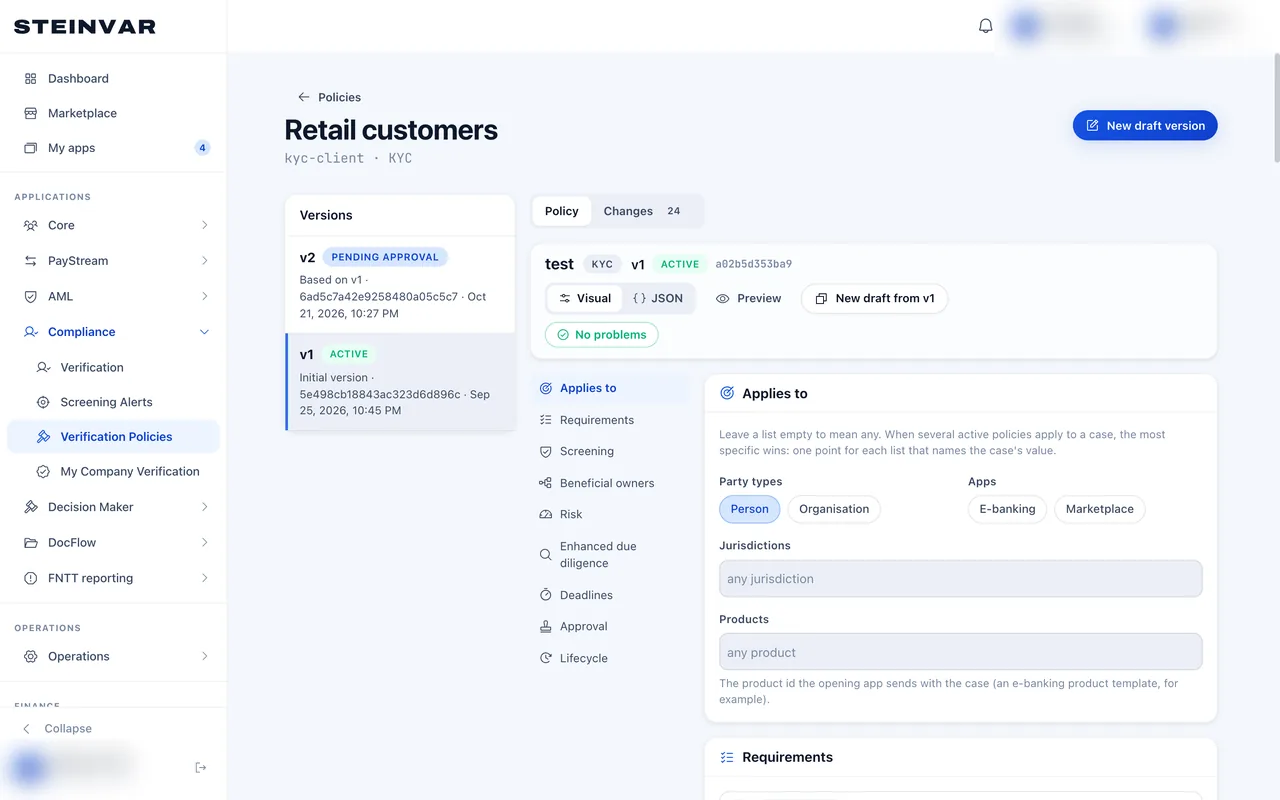
The HQ back office; the workplace and people’s names are blurred.
- ICAO 9303
- ePassport chip, passive and active authentication
- Hash-chained
- record of every case decision, per workplace
- Two
- reviewers to clear a possible sanctions match
Policies and cases
Versioned policies
Requirements per customer type, risk and country, edited in a visual editor and published under maker-checker.
Case state machine
Each case moves through defined states with a revision guard; requirements can be waived with a reason, and every move is audited.
Reviewer queue
SLAs, QA sampling, escalation to senior reviewers, and replies from the customer that resubmit the case.
Evidence
Documents
Image quality, MRZ reading and ICAO specimen checks on passports, ID cards and residence permits, every upload malware-scanned.
ePassport chip
The chip read and authenticated, passively against the issuing country’s CSCA and actively against cloning.
EUDI Wallet
Identity presented from a European Digital Identity Wallet over OpenID4VP with SD-JWT credentials.
Companies
Registry lookups
GLEIF and the Lithuanian Register of Legal Entities for company data and LEIs.
Ownership graph
Beneficial owners resolved through the ownership chain; owners and directors verified, and related parties screened.
Risk
Risk rating
A Decision rule set rates each customer from the case’s data.
Enhanced due diligence
For PEPs, high-risk third countries and nationalities: source of funds and wealth, and senior approval.
Periodic review
Re-review on a schedule by risk, and when the customer’s profile changes.
How a case runs
Open
Onboarding or a profile change opens a case under the policy in force.
Collect
The customer provides documents, a chip read or a wallet presentation.
Check
Documents, registries, ownership and sanctions screening run; hits go to reviewers.
Decide
A reviewer approves, or a senior approves where EDD applies; the decision is chained.
Gate
Only a verified customer opens products and pays, in the back office and in e-banking.
Controls built in.
Four-eyes approval
Policies are published under maker-checker; open alerts and prohibited risks block approval.
Tamper-evident record
Each workplace’s case decisions form a hash chain, anchored and verifiable.
Encrypted evidence
Case data and identity scans are encrypted field by field.
Standards and formats
- ICAO 9303
- OpenID4VP
- SD-JWT
- GLEIF LEI
- AML Directive EDD
Not in this module today
- Liveness and face matching are switched off until they are calibrated.
- Commercial ID-verification, PEP and adverse-media feeds plug in through a provider; none is connected today.
Questions about Steinvar Verify
Can we change our onboarding policy ourselves?
Yes. Policies are versioned and edited in a visual editor; a new version is published under maker-checker and applies to new cases.
What stops an unverified customer from paying?
The verification gate: product opening and payments check the customer’s verification in the back office and in e-banking.